
If you have collected two or three ADU quotes in Los Angeles, you have probably seen them land tens of thousands of dollars apart. One builder quotes $150,000. Another quotes $230,000. Same backyard, same general idea.
The gap usually is not one builder gouging and another giving you a deal. It is that the two quotes include different things. This article breaks an ADU estimate into its actual parts so you can read any quote you receive and compare them fairly.
The three layers of an ADU cost
Every ADU estimate, whether the builder shows it to you this way or not, is built from three layers: base construction, soft costs, and add-ons. On top of those sit the builder’s margin and a contingency reserve. When two quotes differ, the difference is almost always hiding in one of these layers.
Layer 1: Base construction cost
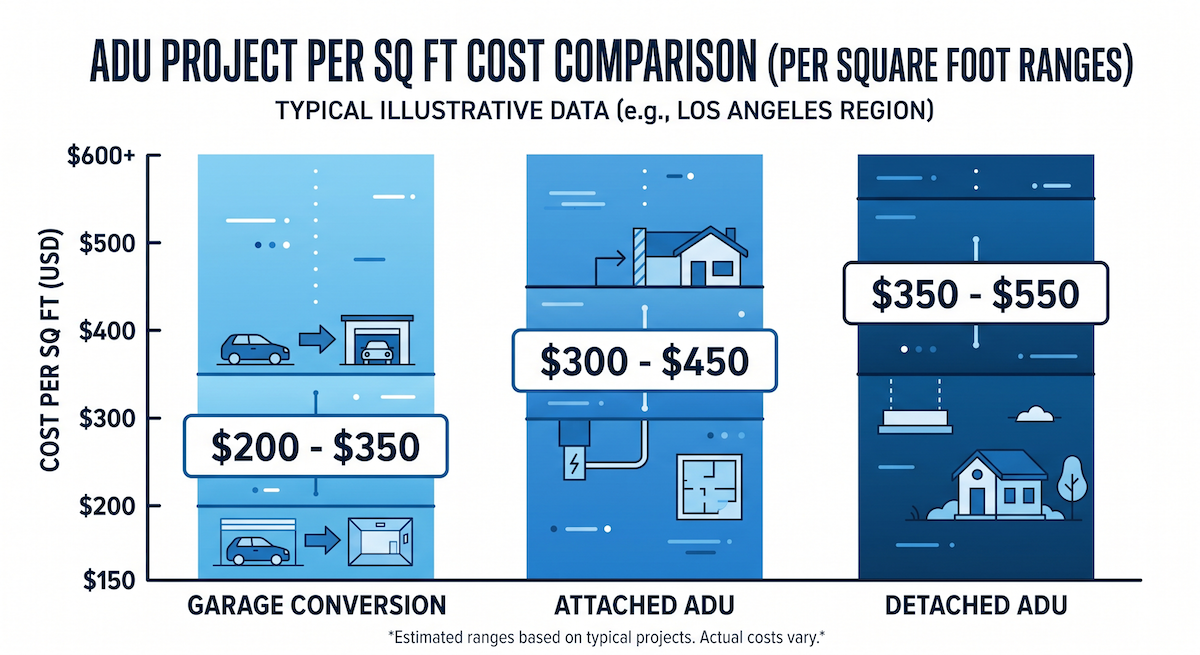
Base construction is the shell and finish of the unit, priced per square foot. The rate depends on the type of ADU and the finish level you choose. These are realistic 2026 Los Angeles ranges:
- Garage conversion: $245 to $395 per square foot. The structure already exists, so this is usually the lowest cost path.
- Attached ADU: $475 to $675 per square foot. Shares a wall with the home but is a fully independent unit.
- Detached ADU (new build): $525 to $675 per square foot. A standalone structure in the yard, and the most flexible option.
Finish level moves you within each range. A basic finish sits at the bottom, a standard finish in the middle, and a premium finish with upgraded cabinetry, flooring and fixtures pushes toward the top. A 400 square foot garage conversion at a standard rate of $295 per square foot is $118,000 in base construction alone, before anything else is added.
Layer 2: Soft costs
Soft costs are the one-time fees that get the project designed, engineered and approved. They are easy to leave off an early quote, which is one of the most common reasons a low number creeps up later. Typical Los Angeles ranges:
- Architectural plans and design: $7,500 to $20,000, depending on complexity.
- Structural engineering: $3,500 to $8,000. Required for any ADU, and higher for older garages.
- City permits through LADBS: $1,500 to $5,000. Garage conversions under 500 square feet often avoid impact fees, and permit costs vary from one property to another.
- Title 24 energy compliance: $800 to $1,800. Required for all new residential construction in California.
On a typical project, soft costs together run in the $15,000 to $30,000 range. A quote that does not mention design, engineering, permits and Title 24 is not a complete quote.
Layer 3: The add-ons that quietly move the number
This layer is where most of the spread between competing quotes lives. These items are priced separately because not every project needs every one, but on real Los Angeles lots, several usually apply:
- Solar panels: $8,000 to $18,000. Required for new ADU construction under California’s solar mandate, though garage conversions of an existing structure are often exempt.
- Fire sprinklers: $5,500 to $12,500. Sometimes required for ADUs, depending on the project.
- Electrical panel upgrade from 100A to 200A: $5,500 to $8,500. Most older LA homes have 100A panels and an ADU usually needs the upgrade.
- Sewer lateral connection on a long run: $8,500 to $15,000. Driven by how far the ADU sits from the main line.
- Mini-split HVAC system: $6,500 to $12,500. The most common heating and cooling setup for an ADU.
- Foundation reinforcement: up to $25,000. Many older LA garages need it before they can carry a conversion.
A quote that excludes solar, sprinklers and a panel upgrade can look thousands of dollars cheaper than a complete one, right up until those items reappear as change orders. The honest comparison is total scope, not headline price.
Contingency, and how builders handle margin
Two final lines sit on top of the subtotal. The first is a contingency reserve, usually around 10 percent, set aside for the surprises that nearly every older property hides behind a wall or under a slab. A complete quote includes one. A quote with no contingency is not a bargain; it usually means those costs surface later as change orders, when you have less leverage to push back.
Margin is handled differently from builder to builder, and this is where comparisons get tricky. Some general contractors add a separate margin line of 15 to 25 percent on top of the subtotal. Others, including builders who self-perform most of the work rather than marking up subcontractors, build their margin directly into their per square foot and line-item rates, so you will not see a separate margin line at all. Neither approach is wrong. It does mean you cannot compare two quotes on the margin line alone. Compare the all-in total for the same scope.
A real example, line by line
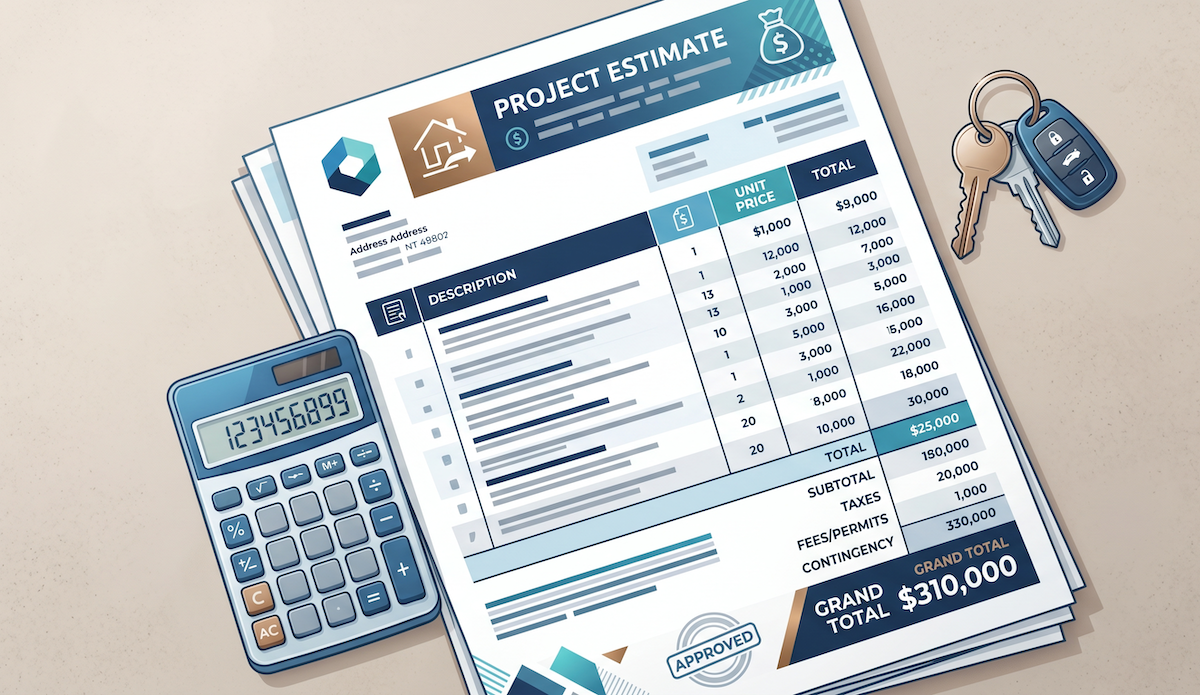
Here is how a common project pencils out: a 400 square foot garage conversion, standard finish, with a panel upgrade and mini-split HVAC, and no solar, sprinklers, long sewer run or foundation reinforcement needed.
- Base construction (400 sq ft at $295): $118,000
- Design, engineering, permits and Title 24: $20,700
- Mini-split HVAC: $9,500
- Electrical panel upgrade: $7,500
- Subtotal: $155,700
- Contingency reserve (10 percent): $15,570
- Total estimate: $171,270
That works out to roughly $428 per square foot, with a realistic range of about $146,000 to $197,000 once you allow for the plus or minus 15 percent that most projects move within. There is no separate margin line here because it is built into the rates. Add solar, fire sprinklers, a long sewer run or foundation work and the number climbs quickly, which is exactly why two quotes for the same backyard can look so different.
What an honest ADU quote should include
Before you sign anything, make sure the estimate names the ADU type and square footage, the finish level, every soft cost, every add-on the site requires, and a contingency reserve. Ask each builder how they handle margin, whether as a separate line or built into their rates, so you are comparing like for like. If two builders are far apart, line their quotes up against this list and you will usually find the difference in minutes.
Frequently Asked Questions
Why do ADU quotes in Los Angeles vary so much?
Because they often include different scopes. One quote may leave out solar, sprinklers, a panel upgrade or contingency while another includes them, and builders handle margin differently. When you compare the all-in total for the same scope, the gap usually disappears.
How much does an ADU cost per square foot in LA in 2026?
Garage conversions run roughly $245 to $395 per square foot, attached ADUs $475 to $675, and detached new builds $525 to $675, before soft costs and add-ons. All-in, a garage conversion often lands in the mid $400s per square foot, while detached new builds run higher.
What are soft costs on an ADU project?
Soft costs are the one-time fees for design, structural engineering, city permits through LADBS, and Title 24 energy compliance. Together they typically add $15,000 to $30,000 and are required, not optional.
What is a contingency reserve and do I need one?
A contingency is money set aside, usually around 10 percent, for conditions that cannot be seen until work begins, such as old wiring or a weak foundation. A quote without one tends to surface those costs later as change orders.
Does a cheaper ADU quote actually save me money?
Not always. A lower number often reflects a narrower scope. Once the missing items are added back during construction, the final cost frequently matches or exceeds a complete quote that looked higher at first.
| Want a clear, itemized ADU estimate?
Ground Up Builders provides detailed, line-by-line ADU estimates after a free site assessment across Greater Los Angeles, Orange County and Ventura County. You will see exactly what is included, with no surprises. Visit groundupbuilders.com | Free estimates, no obligation. |